

💼 Step 3bba: Your Job — Love It or Hate It
🎯 Purpose of This Course
Your job is one of the most powerful forces shaping your financial and emotional life.
Whether you love it, tolerate it, or despise it, your job directly affects your energy, decisions, and long-term wealth.
Step 3bba: Your Job — Love It or Hate It helps you understand, evaluate, and strategically use your job — even if it’s not your dream one — to move you forward on your Life’s Wealth Quest.
This course teaches you how to balance passion and practicality, turn frustration into fuel, and transform any job into a purposeful tool for your future freedom.
“Your job doesn’t define you — it funds you.”
🧭 What You’ll Learn
-
How to identify if your job is serving or draining you
-
The 4 Quadrants of Job Alignment framework
-
How to transition from resentment to strategy using the Investor Mindset
-
How to know when to stay, when to pivot, or when to leave
-
The 12-Month Job Evolution Plan for structured transitions
-
How to rebuild motivation with the Appreciation Reset method
-
The Love It, Leverage It, or Leave It decision system
-
How to align your career path with your Freedom Flow lifestyle vision
🏦 Core Topics Covered
-
The Emotional Economics of Work
-
Energy and stress management in your career
-
Purpose alignment and career satisfaction tests
-
Emotional wealth vs. financial wealth balance
-
Job redesign and skill evolution strategies
-
The Investor Mindset — how to use your job as capital
-
Emotional reset and gratitude psychology
-
Career Capital: Skills, Network, Reputation
-
The 5-Year Emotional Wealth Plan
📈 Course Format
-
Sections: 20 structured lessons + reflection exercises
-
Includes:
-
4 Quadrants of Job Alignment Chart
-
12-Month Job Evolution Plan Template
-
Job Purpose Reflection Worksheet
-
30-Day Appreciation Reset Journal
-
“Love It, Leverage It, or Leave It” Decision Guide
-
6 Real Case Studies
-
-
Format: Printable or digital workbook compatible with the Life’s Wealth Quest Step 3 framework
🚀 Who This Course Is For
-
Individuals who feel stuck, bored, or burned out at work
-
Anyone unsure whether to stay, switch, or redesign their current job
-
Professionals wanting to align purpose with pay
-
Entrepreneurs returning to stability after burnout
-
Anyone ready to transform their emotional relationship with work
🪜 What Makes It Different
This isn’t another “quit your job” course. That doesn't work. If someone says this, run away.... Have a plan like ours
It’s about taking control — emotionally, mentally, and financially — over how your job fits into your wealth story.
You’ll learn that even if you dislike your work, it can still serve as an investor in your dreams.
And if you love it, you’ll discover how to protect that passion from burnout while expanding your opportunities.
“You don’t have to love your job to win with money — but you do have to lead your job, not let it lead you.”
🏁 Expected Outcomes
By the end of this course, you will:
-
Understand your emotional relationship with work
-
Know whether to stay, grow, pivot, or leave your job strategically
-
Have a 12-month plan for skill and career evolution
-
Be able to transform frustration into motivation and progress
-
Feel emotionally balanced and in control of your income path
-
Use your job — love it or not — as the foundation of your wealth system
✨ “Every job has a purpose — when you find it, you find peace.”
📘 Introduction — The Relationship With Your Work
Everyone has a relationship with their job.
For some, it’s comfort.
For others, it’s captivity.
But your job — whether you love it or hate it — plays a vital role in your financial story.
It pays your bills.
It funds your freedom.
It shapes your daily mood, confidence, and sense of purpose.
The goal of this course is not to make you quit your job or pretend to adore it — but to help you understand it, use it, and reshape it into something that aligns with your path to wealth and happiness.
“Your job is either your anchor or your engine — the difference is your mindset.”
🧭 Section 1: The Emotional Economics of Work
Your job doesn’t just affect your wallet — it affects your mental and physical health.
When you hate your job, it drains your energy and clouds your decision-making.
When you love your job, it fuels momentum and creativity.
That emotional impact ripples through every part of your wealth system.
💡 The 3 Emotional States of Employment

Before you decide what to do about your job, you must identify which state you’re living in — because each one requires a different strategy.
💬 Section 2: Case Study 1 — The Disengaged Engineer
Profile: Daniel, 38, mechanical engineer, $84,000 salary.
Competent, respected — but completely bored.
His productivity fell, and he started daydreaming about quitting.
After reflection, he realized he didn’t hate engineering — he hated routine.
He requested to join R&D instead of maintenance.
Work reignited, performance soared, and he later patented a new product part — earning a 10% bonus and profit-sharing stake.
“I didn’t need a new career. I needed a new challenge.”
💡 Section 3: The 4 Quadrants of Job Alignment
Use this framework to analyze your relationship with your work:

Every job fits somewhere in this matrix — and where you are determines your next move.
🧠 Section 4: The “Why I Work” Inventory
Before making big decisions about your career, define why you work.
List your top three motivations:
-
_________ (Security? Passion? Impact? Freedom?)
-
-
If your current job satisfies at least one of these, it still serves a purpose.
If it satisfies none, it’s time to plan your pivot.
“Don’t quit out of emotion — pivot out of purpose.”
💬 Section 5: Case Study 2 — The Content but Capped Nurse
Profile: Mia, 33, registered nurse.
Loved patient care but dreaded hospital politics.
Decided not to quit — instead, she transitioned to telehealth.
Kept her passion, increased income, and reduced burnout.
“I didn’t escape nursing. I evolved it.”
💡 Section 6: Turning Job Frustration into Fuel
Hatred of your job can be harnessed — if you use it correctly.
🔥 Transform Frustration into Motivation
Write your pain points. (“I hate wasting time,” “I hate being undervalued.”)
Flip each into a goal. (“I’ll start my own schedule,” “I’ll raise my market worth.”)
Act on one small fix per month.
Pain is a powerful teacher if you convert it into progress.
🧭 Section 7: The 12-Month Job Evolution Plan
You don’t need to make impulsive changes — you need a structured transition strategy.

💬 Section 8: Case Study 3 — The 12-Month Pivot
Profile: Andre, 40, middle manager.
Hated corporate politics, but needed benefits for his family.
Used the 12-Month Plan:
-
Q1: Reflected and accepted job as temporary investor.
-
Q2: Completed digital marketing certification.
-
Q3: Freelanced on weekends.
-
Q4: Landed remote marketing role + 20% pay bump.
“A year ago I was stuck. Today I’m free — because I made a plan, not a leap.”
💡 Section 9: The Investor Mindset
If you hate your job but need the money, see yourself as an investor:
Your employer pays dividends for your time — use that capital to buy your future freedom.
Example
-
Work = Income Stream
-
Income Stream = Debt Crusher + Wealth Builder Buckets
-
Buckets = Future Options
When you reframe your job as your investor, resentment turns into strategy.
🧭 Section 10: Signs It’s Time to Stay vs. Go
Never sacrifice health or relationships for income — that’s financial self-sabotage disguised as responsibility.

💬 Section 11: Case Study 4 — The Overachiever Burnout
Profile: Sharon, 28, paralegal.
Worked 60+ hours, making great money but developing anxiety.
Realized “busy” wasn’t progress.
Downshifted to 40 hours, started a hobby Etsy store.
Income dipped 10%, but happiness and health skyrocketed.
“My job didn’t destroy me — my inability to pause did.”
💡 Section 12: The Main Income Purpose Test
A job’s worth is measured in more than dollars. It should also provide direction, development, and dignity.
The Main Income Purpose Test helps you decide whether your current job is aligned with your long-term wealth and life design—or if it’s quietly holding you back.
This test examines your work through five essential lenses:
1️⃣ Financial Purpose — Does It Fund Your Freedom?
Your job should do more than pay bills; it should finance progress.
Ask:
-
Am I earning enough to meet the 50/30/20 balance?
-
Does my income produce surplus cash for Debt Crusher or Wealth Builder Buckets?
-
If I received a raise tomorrow, do I have a plan for it—or would it vanish?
If your paycheck disappears every month without trace, the issue isn’t only your wage; it’s your wealth direction.
✅ Action: Create a “Purpose Allocation Plan.” Direct at least 25 % of every raise or bonus toward long-term goals.
2️⃣ Growth Purpose — Does It Expand Your Value?
Even a well-paying job becomes dangerous if it stops growing you.
Ask:
-
Have I learned something new at work this year?
-
Does this role expose me to new tools, systems, or ideas?
-
Do I have a mentor—or have I become one?
A stagnant role limits both income and imagination.
✅ Action: Every 90 days, identify one growth metric (skill, certification, project) that moves you closer to next-level opportunity.
3️⃣ Emotional Purpose — Does It Strengthen or Drain You?
Your emotional energy is fuel for your wealth journey. A job that constantly depletes it becomes a leak in your system.
Ask:
-
Do I finish most days proud or resentful?
-
Is my stress productive (stretching) or destructive (suffocating)?
-
Do I bring home peace or pressure?
If your answer leans toward depletion, it’s time to rebalance—not necessarily by quitting, but by redesigning boundaries, workload, or attitude.
✅ Action: Introduce one boundary that restores energy—longer breaks, “no email after 7 p.m.,” or one mental-health day monthly.
4️⃣ Purpose Alignment — Does It Match Who You’re Becoming?
Sometimes your job fits who you were, not who you’re becoming.
Ask:
-
Does this role align with the person I’m growing into?
-
Do I feel proud telling others what I do—or do I feel the need to explain it away?
-
Would my future self thank me for staying here another year?
Misalignment creates quiet dissatisfaction that money can’t fix.
✅ Action: Write a “Future Thank-You Letter.” Describe how your ideal future self talks about your work. Then measure your current job against that vision.
5️⃣ Social Purpose — Does It Connect You to the Right People?
Wealth often flows through relationships. Your job should expand your network with mentors, peers, and connectors—not just coworkers.
Ask:
-
Am I surrounded by people who challenge and inspire me?
-
Does my environment encourage growth or gossip?
-
Who at work could open a door for me in five years?
✅ Action: Each month, build one intentional connection—coffee with a leader, LinkedIn conversation, or collaboration across departments.
🧭 Scoring Your Main Income Purpose Test
Rate each lens 1 (weak) to 5 (strong).
Lens Score (1-5)
Financial
Growth
Emotional
Purpose Alignment
Social
Total / 25 = ____ % Purpose Score
20 – 25 (Excellent): Your job fully supports your wealth plan—maximize it.
14 – 19 (Fair): Good base, but missing alignment or growth—refine it.
9 – 13 (Low): Your job funds survival, not progress—restructure or plan exit.
< 9 (Critical): Your job drains more than it gives—begin transition within 12 months.
🧩 Putting Your Results to Work
-
High Score (18 +): Optimize—ask for advancement, document wins, and reinvest raises.
-
Medium Score (13 – 17): Adjust—fix what’s broken before fleeing.
-
Low Score (≤ 12): Pivot—create a 12-month exit or retraining plan.
Tie your outcome to your Five-Year Emotional Wealth Plan so you can track not only dollars but joy.
“A purpose-driven job doesn’t always feel perfect day to day—but every day it moves you closer to who you’re meant to be.”
💡 Section 13 — Loving Your Job Again: The Appreciation Reset (Expanded Edition)
When frustration builds, gratitude fades — and with it, your sense of purpose.
You begin seeing your job not as a platform for possibility but as a prison cell of repetition.
The truth? Gratitude doesn’t make you complacent — it makes you clear.
It reawakens awareness of what’s working, even amid what isn’t.
That clarity refuels creativity, emotional stability, and ultimately your wealth decisions.
“The fastest way to feel rich is to recognize what you already have.”
🌅 The Science of Appreciation
Research shows gratitude rewires the brain.
When you acknowledge positive aspects of your work — no matter how small — dopamine and serotonin levels rise.
That biochemical shift improves focus, performance, and resilience.
Financially, this matters.
When you operate from gratitude, you’re less likely to engage in impulsive “escape spending” (buying things to numb job frustration).
Instead, you begin redirecting that energy into productive action — skill-building, saving, or planning a transition.
In short:
Gratitude isn’t passivity. It’s a productivity enhancer.
🧭 The 3 Levels of Appreciation Reset
Level 1: Surface Gratitude (Stabilizing Phase)
Start small. Each morning, identify one specific part of your job you appreciate today.
Examples:
-
“My paycheck comes on time.”
-
“I get to learn from clients every week.”
-
“My coworkers make me laugh.”
Don’t worry if it feels forced at first — repetition builds recognition.
After two weeks, you’ll notice your mind automatically looks for positives instead of problems.
✅ Goal: Replace emotional exhaustion with awareness.
Level 2: Strategic Gratitude (Reframing Phase)
Once you’ve regained awareness, upgrade appreciation into strategy.
Ask:
-
“How does this job fund my Freedom Flow?”
-
“Which skills here can I transfer to my next opportunity?”
-
“What benefits or experiences could I be overlooking?”
Example:
A call-center worker might realize:
“This job is teaching me persuasion and communication — the same skills that will help me sell real estate later.”
✅ Goal: Turn appreciation into leverage.
Level 3: Transformational Gratitude (Expansion Phase)
At this stage, gratitude transforms from emotion into energy.
You start using it to uplift others and multiply value.
Actions:
-
Mentor a new hire.
-
Send appreciation to a helpful colleague.
-
Thank your supervisor for specific leadership moments.
These micro-acts of recognition elevate your visibility and reputation — often leading to opportunities you never expected.
✅ Goal: Use gratitude as a currency that builds career capital.
“What you appreciate appreciates in value.”
📊 The Appreciation-to-Action Framework
This framework connects emotional appreciation to practical growth.

By completing this five-step loop daily or weekly, you anchor positive awareness into practical motion — a critical link in sustainable wealth-building.
🧠 Gratitude and the Wealth System Connection
Every bucket in your Overflow System thrives when you feel grateful:

Gratitude isn’t an accessory to wealth; it’s the engine oil that keeps the whole system running smoothly.
💬 Case Study — The Manager Who Relearned Appreciation
Profile: Olivia, 45, corporate department head.
After 18 years in the same company, she’d lost enthusiasm and perspective.
Team morale dropped, and burnout spread.
She began a 30-Day Appreciation Reset Journal:
-
Wrote 3 daily positives (team success, supportive colleague, financial stability).
-
Expressed gratitude publicly once a week.
By Day 20, her team noticed her renewed energy — engagement rose 40%.
She was later offered a regional director role.
“I didn’t change companies. I changed my focus — and my career changed it.
📓 30-Day Appreciation Reset Template
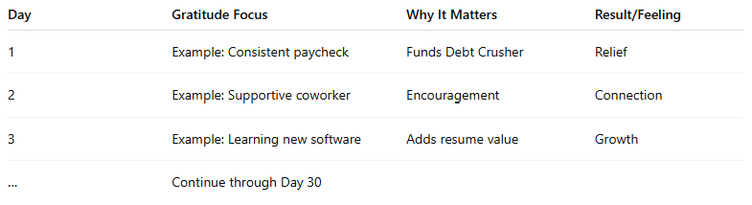
You’ll notice tangible emotional shifts by Day 10 and increased motivation by Day 21.
The key is consistency, not intensity.
🌠 Gratitude Is Strategic, Not Sentimental
When you treat appreciation as strategy, it does three things simultaneously:
-
Reprograms mindset — from victim to investor.
-
Improves performance — people who appreciate their work deliver higher-quality results.
-
Attracts advancement — gratitude radiates reliability and leadership.
“Gratitude doesn’t mean settling. It means standing tall while you plan your next climb.”
🧭 Next Step: From Appreciation to Intention
Once you’ve completed your 30-day reset, move to intentional action:
-
Identify one person to thank formally.
-
Identify one process to improve at work.
-
Identify one skill to enhance in the next 90 days.
Gratitude grounds you; intention propels you. Together, they create sustainable momentum.
💬 Section 14: Case Study 5 — The Mindset Flip
Profile: Paul, 52, factory supervisor.
Felt stuck and undervalued; ready to retire early.
Tried 30-Day Reset: began mentoring younger workers.
Energy revived, management noticed — got leadership training and a $5,000 raise.
“I learned that gratitude didn’t make me weak — it made me promotable.”
💡 Section 15: Building Career Capital
Your job — even one you dislike — can build assets that outlast employment.
Career Capital = Skills + Network + Reputation.

You can hate your tasks but still build lasting capital.
🧭 Section 16: Turning Job Love into Leverage
If you do love your job — use that enthusiasm wisely.
-
Volunteer for growth projects.
-
Document results for future raises or portfolios.
-
Start side teaching or mentoring in your field.
-
Protect your energy so passion doesn’t become burnout.
Love is powerful fuel — if directed strategically.
💬 Section 17: Case Study 6 — The Passionate Builder
Profile: Jasmine, 30, fitness trainer.
Loved her job but earned inconsistently.
Created digital courses teaching beginner trainers.
Doubled income and gained flexibility.
“I stopped chasing clients and started building systems.”
💡 Section 18: The 5-Year Emotional Wealth Plan
Track both financial and emotional health:

Wealth without joy is just survival with money.
🧭 Section 19: Reflection Exercise — Your Work Truth
Answer honestly:
-
What’s the single best part of your job?
-
What’s the hardest part emotionally?
-
What’s one thing you could change right now to make it 10% better?
-
If you could design your ideal work-life, what would it look like?
These reflections help uncover your next right move.
💡 Section 20: Final Framework — Love It, Leverage It, or Leave It

The key is to decide consciously — not emotionally.
🏁 Conclusion — You Don’t Work for a Job, You Work for a Life
Your job is a tool, not a trap.
Whether you love it or hate it, it’s shaping your path to financial freedom.
When you learn to master the emotional and strategic balance between gratitude, leverage, and growth, your job stops defining you — and starts building you.
“Love it or hate it, your job can serve you — if you make it part of your plan.”
You now have the mindset, systems, and strategies to transform how you view and use your main income source — not as a burden, but as the foundation of your freedom.