

📖 Step 1cd:
How to Spot the Hypocrites
🌫️ Introduction: The Hypocrisy Trap
💡 Icon: Magnifying Glass – Because spotting hypocrisy requires sharp observation.
Wealth, personal growth, and leadership all demand clarity, integrity, and alignment. Yet, across every industry—whether it’s finance, self-help, business coaching, or even relationships—there exists a group of people who speak loudly about values they don’t actually live. These are the hypocrites.
They say, “Do as I say, not as I do.”
They build authority on words while their actions paint a very different picture.
⚠️ Hypocrisy is not just annoying—it’s dangerous. It misleads those who genuinely want to grow. It diverts time, money, and energy into false paths. And it spreads disillusionment, making people believe that success is only for the lucky or dishonest.
This lesson will teach you how to:
-
✅ Spot hypocrites in business, finance, and self-development.
-
🚫 Avoid falling into their traps.
-
🔑 Build filters so you only learn from people who walk the walk.
-
📌 Strengthen your own integrity so you never become one yourself.
By the end, you’ll have a radar system for hypocrisy—an internal toolset that saves you from being misled and strengthens your trust in yourself.
1. Introduction: Why Financial Gurus Are a Breeding Ground for Hypocrisy
Financial gurus hold a unique place in society. They claim to hold the keys to wealth, stability, or financial freedom, and they often attract huge audiences by simplifying complex topics like debt, investing, retirement, and entrepreneurship. They preach discipline, delayed gratification, and conservative approaches for their audiences while sometimes living by entirely different rules themselves.
This creates fertile ground for hypocrisy. When someone claims that “everyone should follow these steps” but has not actually followed those steps themselves—or worse, achieved success in the exact opposite way—they set up millions of people to fail while profiting from their confusion.
The issue is not whether these gurus offer some good advice. Many do. The issue is whether their personal example aligns with their public teaching. If the gap is too wide, their credibility collapses.
Case Studies
Case Study One: Dave Ramsey — The Debt-Free Preacher Who Built Wealth Through Debt and Courses
Dave Ramsey is perhaps the most famous modern American financial guru. His entire brand revolves around debt avoidance. He preaches that debt is evil, that credit cards should never be used, and that the only path to wealth is through saving, budgeting, and slow compounding. His “Baby Steps” system is designed to take families from chaos to control.
Background:
Dave Ramsey’s story is familiar to millions. He built a real estate empire in his 20s, only to watch it collapse when banks called in loans. Out of that disaster, he built his “Baby Steps” program, which teaches families to pay off debt, live on cash, and build wealth slowly. He now runs Ramsey Solutions, a company with over 1,000 employees, a nationally syndicated radio show, and multiple best-selling books.
Core Advice:
-
Never borrow money (not even for cars, credit cards, or student loans).
-
Follow the Baby Steps: save $1,000, pay off all debt, build 3–6 months of emergency funds, invest 15% of income, pay off mortgage early, then build wealth and give.
-
Live frugally, with no exceptions.
But how did Dave build his fortune? The answer reveals hypocrisy. He made his early money through real estate—specifically, by leveraging large amounts of bank loans. When the market turned against him in the late 1980s, he lost it all. This failure gave him the foundation for his debt-free philosophy.
How He Built Wealth:
-
Real estate (with heavy debt in his 20s).
-
Books, radio, and courses.
-
A subscription program (Financial Peace University) that charges families to access his teachings.
-
Licensing deals and partnerships with financial institutions.
The problem is that while he now tells others to avoid debt entirely, he himself re-entered wealth by leveraging modern tools he discourages. Ramsey Solutions, his company, is built not by following his own Baby Steps, but by selling courses, books, and radio programs. His fortune—estimated at hundreds of millions—is based on persuading people to follow his simplified rules, while his own wealth came primarily from building a media empire.
The hypocrisy lies here: ordinary followers are told that debt and risk are unacceptable, but Ramsey himself took entrepreneurial risks, benefited from scale, and now lives with privileges far outside the average person’s reach. He sells discipline while living in abundance made possible by teaching, not by living his rules.
The Hypocrisy:
-
Ramsey tells followers never to borrow money, but he himself borrowed heavily to start. His empire exists because he took risks he forbids others to take.
-
His net worth was built not from following his Baby Steps but from selling his Baby Steps. The average follower doesn’t become wealthy through his plan; Ramsey became wealthy through their subscriptions.
-
His company’s retirement plan (401k) reportedly uses some of the very financial vehicles he criticizes for average investors.
Lessons Learned:
-
His principles (living debt-free, avoiding overspending) are useful for those in chaos.
-
But the hypocrisy shows that rigid rules don’t build extraordinary wealth. Discipline can stabilize, but growth requires risk.
Self-Study Reflection:
-
Have I confused stability with growth? Am I following rules that keep me safe but not wealthy?
-
Am I idolizing a guru’s story without checking whether their wealth came from the system they sell?
Exercise:
Write down Ramsey’s Baby Steps. Then write down your actual steps toward wealth. Compare: is your journey stabilizing you—or building wealth? Which do you really need?
Case Study Two: Suze Orman — The Fear-Based Advisor Who Doesn’t Follow Her Own Rules
Suze Orman rose to fame by delivering sharp, no-nonsense advice, often tinged with fear. She tells people not to buy coffee, not to buy cars, not to invest in risky assets, and to avoid behaviors that jeopardize retirement. She presents herself as the financial guardian of the middle class.
Background:
Suze Orman built her career on television and bestselling books. She positioned herself as the voice of financial responsibility, especially for women and families. Her advice often uses urgency and fear: “If you don’t stop buying coffee, you won’t retire!”
Core Advice:
-
Avoid small luxuries (“The Latte Factor”).
-
Don’t buy cars, fancy clothes, or anything frivolous.
-
Save aggressively, avoid debt, and focus on long-term retirement funds.
But her personal history reveals contradictions. She has sold expensive prepaid debit cards that disproportionately harmed the same lower-income people she claimed to protect. She has promoted financial products for commissions while warning others about conflicts of interest. She has told ordinary people not to chase high returns, while investing her own wealth aggressively and living a luxury lifestyle.
How She Built Wealth:
-
Books and TV appearances.
-
Product endorsements, including prepaid debit cards.
-
Media partnerships.
Her hypocrisy is sharpened by the tone of her advice: harsh, critical, moralizing. Followers who stumble feel guilt, while Suze herself enjoys wealth that didn’t come from following the advice she sells, but from building a brand on television and media partnerships.
The Hypocrisy:
-
Orman tells people to avoid fees, yet sold prepaid debit cards that were loaded with hidden fees.
-
She warns against risk while investing her own wealth aggressively.
-
She lives a luxury lifestyle far beyond the reach of those following her cut-every-corner philosophy.
Lessons Learned:
-
Fear-based advice can control people but rarely empowers them.
-
Hypocrisy thrives when someone sells “discipline” while personally enjoying abundance made possible by selling discipline, not by practicing it.
Self-Study Reflection:
-
Do I cut small luxuries because of guilt, or because it truly changes my financial trajectory?
-
Am I listening to advice rooted in fear instead of logic?
Exercise:
Track your monthly coffee, food, and “luxury” expenses. Calculate whether cutting them meaningfully accelerates your wealth. Compare to increasing income. Which truly moves the needle?
Case Study Three: Robert Kiyosaki — The “Rich Dad Poor Dad” Paradox
Robert Kiyosaki became a household name with his book Rich Dad Poor Dad, which presents a simple story: one dad taught him the path of poverty, the other the path of wealth. The book preaches financial education, real estate investing, entrepreneurship, and asset building.
Background:
Robert Kiyosaki is best known for Rich Dad Poor Dad. The book has sold tens of millions of copies and introduced millions to the idea of assets vs. liabilities. His brand expanded into seminars, coaching programs, and board games.
Core Advice:
-
Buy assets, not liabilities.
-
Real estate is a path to passive income.
-
Schools don’t teach financial literacy.
-
“The rich don’t work for money.”
How He Built Wealth:
-
Book sales and licensing.
-
High-ticket seminars.
-
Partnerships with companies selling courses.
The hypocrisy problem arises when you examine his background. The “Rich Dad” may not even exist as described. Investigations have revealed that his wealth was primarily built from book sales, seminars, and licensing, rather than massive real estate success. While he promotes rental properties, passive income, and complex tax strategies, most of his followers will never achieve his level of scale.
Kiyosaki often criticizes mainstream financial advice, claiming things like “savers are losers” or “the rich don’t pay taxes,” but his empire thrives on selling high-ticket courses, mentorships, and seminars. He makes money not from practicing his lessons at massive scale, but from teaching the lessons as a product.
His hypocrisy emerges when he dismisses traditional paths as traps but then makes millions selling people an alternative that is not fully aligned with how he himself got rich.
The Hypocrisy:
-
His “Rich Dad” may not exist. The story that made him famous may be partly fictionalized.
-
He preaches real estate as a wealth engine, but his fortune came from teaching real estate, not owning enough of it.
-
He criticizes savers and traditional jobs, yet profits heavily from those seeking safety.
Lessons Learned:
-
His ideas (assets vs liabilities) are useful as frameworks.
-
But his hypocrisy warns us not to mistake teaching wealth with building wealth.
Self-Study Reflection:
-
Am I more inspired by the story than the facts?
-
Am I chasing “passive income” from a place of fantasy, or building real assets?
Exercise:
Write down all your assets and liabilities. Now, honestly ask: if you removed the story around them, are they cash-producing assets or consumer illusions?
case Study Four: Clark Howard — The “Frugal Expert” with Contradictions
Clark Howard is often seen as a consumer champion. He teaches frugality, careful shopping, credit awareness, and cost-cutting. On the surface, he appears less hypocritical than others, since he genuinely lives much of what he preaches. But even he has contradictions.
Background:
Clark Howard is a consumer advocate. He teaches people to save money on everyday purchases, avoid scams, and live frugally. His advice is practical, often grounded in real consumer data.
Core Advice:
-
Shop smarter, save pennies, avoid unnecessary expenses.
-
Build wealth by living below your means.
-
Use credit carefully and never pay more than necessary.
Howard has invested in real estate, benefited from broadcasting, and built wealth not from coupon clipping, but from scaling media. The average listener who follows his tips may save a few hundred dollars a year, but Clark himself built financial freedom by growing a national platform.
How He Built Wealth:
-
Media career: radio, books, and partnerships.
-
Investments in businesses and real estate.
The hypocrisy here is softer but still present: presenting frugality as a universal path to wealth while enjoying wealth from business ventures outside the reach of ordinary followers.
The Hypocrisy:
-
Howard’s wealth is not from clipping coupons—it’s from building a brand.
-
His advice helps people save small amounts, but his own financial success came from scaling his influence.
-
He lives comfortably while his followers chase small savings.
Lessons Learned:
-
Frugality helps stabilize, but savings alone rarely make millionaires.
-
The hypocrisy is softer, but still real: the wealth comes from selling frugality, not from living on it.
Self-Study Reflection:
-
Am I focusing too much on cutting costs instead of building income?
-
Is saving $300 a year more important than creating $30,000 of value?
Exercise:
Track your savings from “smart shopping” over 90 days. Then brainstorm one way to earn 10x that amount through a side hustle or investment. Compare impact.
Case Study Five: Brian Preston and “The Money Guy Show”
Brian Preston and his co-host present themselves as fiduciary advisors. They talk about discipline, diversified investing, and long-term planning. On the surface, they appear less hypocritical because they practice financial advising and disclose their background.
Background:
Brian Preston and Bo Hanson host The Money Guy Show, which mixes financial planning with accessible education. They present themselves as fiduciary advisors with conservative, proven strategies.
Core Advice:
-
Save early, save often.
-
Invest in diversified funds.
-
Avoid chasing trends.
-
Stick to proven principles.
Yet their show is monetized through YouTube ads, brand partnerships, and exposure that funnels clients to their firm. While they caution others not to chase trends, their own rapid brand growth reflects an entrepreneurial leap that few of their followers could replicate.
How They Built Wealth:
-
Advisory firm fees.
-
Media exposure on YouTube.
-
Brand partnerships and client funnels.
The subtle hypocrisy lies in the mismatch between the conservative advice for followers and the entrepreneurial risks they themselves embraced.
The Hypocrisy:
-
They advise conservative, boring investing but built wealth through entrepreneurial growth of a media empire.
-
They discourage chasing trends, but their YouTube growth relied on following algorithmic trends and content hacks.
-
They present wealth as “simple math,” but their success is based on business leverage.
Lessons Learned:
-
Their principles are solid, but incomplete. True wealth requires both discipline and entrepreneurship.
-
Hypocrisy arises when a safe path is presented as the only path, while the gurus themselves took risks.
Self-Study Reflection:
-
Am I hiding behind “safe” strategies to avoid entrepreneurship?
-
Do I understand the difference between following advice and building at scale?
Exercise:
List your financial strategy. Then list your entrepreneurial strategy. If the second list is empty, ask whether “safe advice” is slowing your growth.
Modern Influencers and TikTok Gurus
Beyond legacy names, the modern landscape is filled with TikTok, Instagram, and YouTube “gurus” who show off luxury cars, rented mansions, and fake trading accounts. They promise fast wealth through crypto, drop shipping, or day trading. Their hypocrisy is the most obvious: they make money not through the systems they sell, but through selling the system itself.
For example:
-
A crypto guru loses money on trades but profits by selling courses.
-
A drop shipping influencer shows rented cars while making money only from affiliate programs.
-
A real estate TikTok star flashes luxury homes but quietly leases them for content.
Background:
The newest generation of financial influencers floods social media with videos promising fast wealth. They flash Lamborghinis, luxury apartments, and stacks of cash. They promise wealth through crypto, day trading, drop shipping, or “secret” hacks.
Core Advice:
-
Get rich quick.
-
Buy this course to learn the system.
-
Quit your job today; money is easy.
How They Built Wealth:
-
Courses, memberships, affiliate programs.
-
Monetizing their social media presence.
-
Selling the dream, not living it.
The hypocrisy is extreme because the image is not even partially real. It is constructed to sell products, not to reflect lived reality
The Hypocrisy:
-
They rarely make money from the methods they sell—only from selling the methods.
-
The cars, houses, and luxury are often rented or borrowed.
-
They preach freedom while living chained to content creation and sales funnels.
Lessons Learned:
-
The hypocrisy is the loudest here: the entire model is built on illusion.
-
Followers who believe the show end up losing money while influencers pocket course fees.
Self-Study Reflection:
-
Am I attracted to the image more than the results?
-
Have I verified whether these gurus make money from the method—or from selling it?
Exercise:
Pick three social media financial influencers. Research their actual business model. Write down whether they make money from investing, trading, or drop shipping—or from selling courses about it.
.
Why Financial Guru Hypocrisy Is So Harmful
Unlike hypocrisy in other domains, financial hypocrisy cuts deeper because:
-
Money is survival. When people follow bad advice, they lose not just time but stability.
-
Financial advice is asymmetrical. Gurus profit whether their followers succeed or fail.
-
False hope damages trust. When followers realize the advice does not work, they may reject all financial education, even the good.
-
Scale magnifies harm. A guru with millions of followers can mislead entire generations.
Red Flags to Spot Hypocritical Gurus
-
They sell courses more than they show real, audited results.
-
Their wealth comes from speaking, not doing.
-
Their advice is rigid, extreme, or moralizing without nuance.
-
They constantly shame followers instead of teaching.
-
They live in ways their advice would not allow.
Self-Study Exercises
-
Write down the names of three financial gurus you’ve followed. List their core advice. Then ask: Did they actually follow this path to wealth themselves?
-
Look at your own financial habits. Are you blindly following a rule (like “never use credit cards”) without asking whether the guru who gave it actually lives by it?
-
Research the real business model of your favorite guru. If they earn most of their money from books, courses, or media—not from practicing their advice—acknowledge the hypocrisy.
-
Journal: How has following hypocritical advice cost me in the past? How can I filter better in the future?
Conclusion: Integrity Over Idols
Financial hypocrisy is everywhere. Gurus build brands by simplifying complex ideas and often by presenting themselves as paragons of discipline, when in reality their wealth was built through scale, risk, or entirely different means. The key is not to reject all advice but to separate the principle from the preacher.
If a guru says “avoid debt,” ask whether the principle is useful for you—even if the guru didn’t live it perfectly. If another says “build assets,” ask what evidence exists beyond their story.
Ultimately, the antidote to hypocrisy is self-reliance. Learn from others, but never idolize them. Look at results, not rhetoric. Judge advice on logic and evidence, not personality. In doing so, you protect yourself from hypocrisy while also ensuring you don’t become a hypocrite in your own financial journey.
Closing Thoughts
Financial gurus often wear masks. They sell systems while living by different ones. The hypocrisy ranges from soft (frugality sellers who live rich) to extreme (influencers who fake everything). The danger is in blindly trusting them.
The solution is clear:
-
Separate principle from personality.
-
Verify results, not stories.
-
Learn, but never idolize.
-
Build wealth your way, not theirs.
-
📺 YouTube Guru's — The New Class
-
The Bad:
-
Hype-Driven: Many made fortunes in the 2020–21 bull market by hyping stocks and crypto that later tanked, leaving followers holding the bag.
-
Conflicts of Interest: Affiliate links, sponsorships, and course sales sometimes bias their advice.
-
Shallow Content: Because videos must be quick and engaging, they often gloss over the complexity of investing, taxes, or business.
-
-
Algorithm Chasers: Content is often driven by YouTube’s algorithm — meaning what gets views, not what’s accurate or sustainable.
-
The Ugly:
-
Entertainment First, Accuracy Second: Their #1 priority is clicks. Which means they sometimes push hype, over-dramatic thumbnails, and “next big thing” investing trends just to keep the algorithm happy.
-
Crypto & Meme Stock Pumping: Many heavily promoted speculative assets during the 2020–2021 boom, only to quietly backtrack after their followers lost money.
-
Conflicted Incentives: They earn from ad revenue, affiliate links, and selling courses — not from following their own advice.
-
Fleeting Authority: Their popularity is platform-dependent; when the algorithm shifts, so does their influence — making them unstable long-term teachers.
-
🧩 Overall Bad Truths About Gurus
-
They Sell Security, Not Wealth: Most make their millions from books, courses, and shows — not from following their own advice.
-
They Oversimplify: In trying to reach mass audiences, they dumb down wealth-building into slogans and one-liners.
-
They Create Dependency: Many build cult-like followings that discourage independent thinking.
-
They Cherry-Pick: Success stories are highlighted, while failures of their systems are rarely discussed.
-
They Monetize Trust: The real business model isn’t wealth creation — it’s audience monetization.
-
They Sell Simple Answers: Wealth is complex, but they market slogans (“Debt-Free!” “Assets vs Liabilities!” “10X Everything!”).
-
They Hide Their Hypocrisy: Many don’t follow the same playbook they teach.
-
They Create Dependency: The “guru effect” makes followers look to them for every decision — instead of thinking independently.
-
They Profit from Fear and Hope: Gurus thrive when people are scared (recessions) or greedy (booms). Either way, they win — even if their followers lose.
🆚 Side-by-Side Comparison
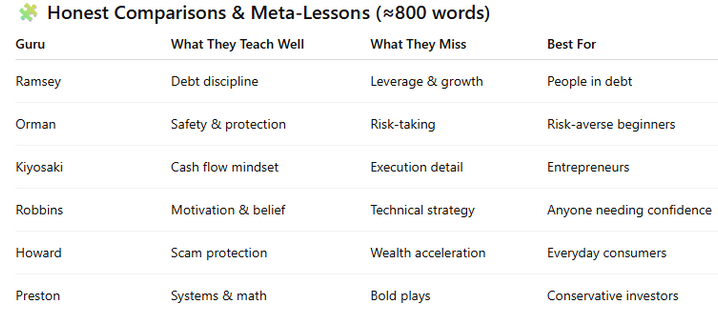
Meta-Lessons:
-
Gurus = partial maps.
-
Truth = scattered across them.
-
Integration = your job.
🏁 Conclusion: The Honest Truth
Gurus are valuable entry points. They awaken, protect, or inspire — but they cannot carry you all the way.
The honest truth: You must build your own integrated wealth system.
That’s where Life’s Wealth Quest steps in: not as a single-voice guru, but as a framework that merges the discipline of Ramsey, the protection of Orman, the cash flow of Kiyosaki, the belief of Robbins, the practicality of Howard, and the clarity of Preston — without their blind spots.
📚 Self-Study Course:
Step 1caa — The Guru’s: An Honest Opinion
📌 Objective
By the end of this self-study course, you will:
-
Recognize the strengths and weaknesses of major financial gurus.
-
Learn how to filter their advice without blind loyalty.
-
Build your personal “Guru Filter” for evaluating future voices.
⏱️ Suggested Pace
-
Total Time: 60–90 minutes.
-
Work across 2–3 sessions, or complete in one sitting.
🗂️ Course Modules
Module 1: Why Gurus Matter
Learn: Why financial gurus dominate the money conversation.
Reflect: Who was the first money guru you heard about? How did they influence you?
Action Worksheet: Write down 2 money beliefs you learned from a guru. Were they true, false, or incomplete?
Module 2: Honest Guru Profiles
Learn: Review the core teachings, strengths, and flaws of Ramsey, Orman, Kiyosaki, Robbins, Howard, Preston, and YouTube gurus.
Reflect: Which guru’s voice has been loudest in your life? Why?
Action Worksheet: Complete the “Guru Scorecard.” For each guru:
-
1 Truth they teach.
-
1 Myth or blind spot.
Module 3: Meta-Lessons
Learn: Gurus are partial maps.
Reflect: If you only followed one guru, where would it lead you (debt-free? safe but stuck? hyped but broke?)
Action Worksheet: Build your “Hybrid Guru Playbook.” Choose 3 truths (from 3 different gurus) you want to keep in your system.
Module 4: Create Your Guru Filter
Learn: Future gurus will emerge.
Reflect: How can you evaluate whether someone is worth listening to?
Action Worksheet: Write your “Guru Filter Questions,” such as:
-
Does this guru practice what they preach?
-
Are they teaching principles or selling hype?
-
Does this align with my wealth vision?
🏁 Completion Checklist
-
I identified 2 money beliefs I absorbed from gurus.
-
I filled out the Guru Scorecard.
-
I built a Hybrid Playbook with 3 truths.
-
I created a personal Guru Filter.