

📖 Step 1caa:
The Guru’s — An Honest Opinion
🌫️ Introduction: Why Honest Opinions Matter
For decades, financial gurus have dominated the airwaves, bookshelves, and now YouTube feeds. They promise freedom, discipline, or cash flow. Millions trust them — sometimes more than their own family.
But here’s the truth: every guru is incomplete. Each one offers a slice of the wealth pie, not the whole recipe. Without an honest evaluation, you risk adopting myths that can slow or sabotage your wealth journey.
This step isn’t about worship or dismissal — it’s about clear-eyed evaluation. By the end, you’ll know who to listen to, what to take from them, and what to leave behind.
🧑🏫 Dave Ramsey: The Preacher of Debt-Free Discipline
-
The Good:
-
Helps millions escape consumer debt.
-
Creates structure for the financially overwhelmed (Baby Steps).
-
Powerful motivator for middle-income families.
-
-
The Bad:
-
Demonizes all debt, including strategic leverage (real estate, business).
-
Unrealistic 12% return assumptions on mutual funds.
-
Neglects entrepreneurship and advanced investing.
-
Anti-Entrepreneurship: Ramsey actively discourages business risk, which is ironic since his own wealth came from building a business empire, not following his Baby Steps.
-
No Nuance in Debt: He lumps all debt together — student loans, mortgages, business credit lines — as “evil.” This mindset keeps people from leveraging low-interest debt to scale wealth faster.
-
Shame Culture: His community often uses guilt and shame, creating toxic environments where people are afraid to talk about financial mistakes.
-
Financial Elitism: He assumes a stable income and access to employer retirement plans — advice that doesn’t fit freelancers, small business owners, or the gig economy.
-
-
The Ugly:
-
Cult-like community pressure.
-
Advice stalls ambitious builders who want more than just debt-freedom.
-
Do As I Say, Not As I Do: Ramsey built his empire by selling books, courses, and coaching programs — not by quietly investing in mutual funds like he preaches. He leveraged business debt early in his career but now condemns it.
-
Cult-Like Control: His organization has been accused of creating a cult environment — firing employees for not adhering to his strict personal conduct rules.
-
Shaming the Poor: His rhetoric often humiliates people for financial mistakes, reinforcing guilt instead of building empowerment.
-
Out of Touch: He often dismisses systemic issues like medical debt, wage stagnation, and housing costs, placing all blame on individuals.
-
Honest Opinion: Ramsey is perfect if you’re drowning. But once you’re afloat, you’ll outgrow him.
👩🏫 Suze Orman: The Guardian of Safety
-
The Good:
-
Emphasizes insurance, wills, trusts, and protection.
-
Popularized financial responsibility for women.
-
Raised awareness about scams and risks.
-
-
The Bad:
-
Fear-based tone discourages risk-taking.
-
Promotes scarcity mindset.
-
Limited pathways to wealth acceleration.
-
Scarcity Thinking: Suze makes people feel guilty about “small luxuries” like coffee — even though wealth is created by income growth, not penny-pinching.
-
-
The Ugly:
-
Fear-Based Products: She’s been criticized for pushing her own branded financial products (like prepaid debit cards) that carried high fees.
-
Anti-Retirement Movement: She criticizes FIRE (Financial Independence, Retire Early), calling it “the biggest mistake you’ll ever make,” showing her lack of imagination for alternative lifestyles.
-
Mixed Track Record: Some of her investment advice in the 2000s contradicted her later positions, leaving followers confused.
-
Profiting Off Fear: She sold high-fee products (like her prepaid debit card) to her own audience while preaching frugality — a clear conflict of interest.
-
Contradictory Advice: She changes her positions depending on what’s trending (e.g., telling people to invest aggressively in the ’90s, then scaring them into ultra-conservatism after crashes).
-
Gatekeeping Retirement: Her harsh critiques of FIRE (Financial Independence, Retire Early) weren’t about protecting people — they revealed her lack of faith in anyone succeeding outside the traditional path she built her brand on.
-
Fear-Mongering Persona: She markets herself by scaring people into inaction rather than empowering them toward calculated risks.
-
Honest Opinion: Suze keeps you safe, but she doesn’t help you soar.
📚 Robert Kiyosaki: The Cash Flow Evangelist
-
The Good:
-
Changed how millions think about assets vs liabilities.
-
Introduced cash flow focus and entrepreneurship.
-
Inspired global conversations around financial education.
-
-
The Bad:
-
Vague, often contradictory advice.
-
Encourages risky leverage with little risk management.
-
Makes money from books and seminars more than investments.
-
Ambiguity by Design: His definitions of “assets” and “liabilities” are oversimplified to the point of misleading. By his standard, your home is never an asset — even though for many families it is a foundation of wealth.
-
Seminar Machine: Much of his fortune has come not from investing, but from selling overpriced seminars and coaching programs.
-
Dangerous Leverage: He encourages debt-fueled investing without teaching risk management, which has led countless followers into foreclosure or bankruptcy.
-
“Rich Dad” Fiction?: Critics argue that “Rich Dad” may have been a composite or even a fictional character, raising questions about the authenticity of his core story.
-
-
The Ugly:
-
Rich Dad? Poor Truth: There’s evidence that “Rich Dad” may be partly or entirely fictional, which means the foundation of his book — the central parable — may have been fabricated.
-
Seminar Empire Scams: His brand has been linked to expensive, upsell-driven seminars accused of misleading attendees with get-rich-quick promises.
-
Contradictions in Advice: He rails against saving money yet invests heavily in gold. He condemns jobs as “Just Over Broke” but made his fortune selling content to employees.
-
Profits from Hype: He benefits most when people are chasing shiny objects (crypto, real estate bubbles), which keeps his followers addicted to new “opportunities.”
-
Honest Opinion: Kiyosaki is the wake-up call you need to think differently — but not the GPS for execution.
🎤 Tony Robbins: The Motivator of Money
-
The Good:
-
World-class motivator who energizes millions.
-
Highlights psychology and limiting beliefs around money.
-
Promotes index investing through experts like Ray Dalio.
-
-
The Bad:
-
Oversimplifies complex investing.
-
Content leans more inspirational than tactical.
-
Lacks technical substance.
-
Surface-Level Finance: His books rely heavily on interviews with other experts — meaning Robbins isn’t giving his financial wisdom, but repackaging others’.
-
Overpromises: Titles like Money: Master the Game suggest he’ll hand you the formula, but much of it boils down to “buy index funds.”
-
Guru Recycling: He promotes voices like Ray Dalio and Paul Tudor Jones, but doesn’t challenge their views, presenting them as gospel.
-
Pricey Events: Robbins’ seminars can cost thousands, and while motivational, many attendees leave without practical steps to actually improve finances.
-
-
The Ugly:
-
Financial “Tour Guide”: Robbins isn’t a financial expert — he piggybacks on credible investors’ names to build authority.
-
High-Priced “Transformation”: His events cost thousands, often preying on vulnerable people desperate for change, leaving them with motivation but little execution power.
-
Over-Sanitized Promises: His Money: Master the Game title is misleading; the book mostly repeats generic index fund advice, far from “mastery.”
-
Allegations & Criticism: Robbins has faced lawsuits and investigative journalism questioning his treatment of staff and event participants — tarnishing the image of his “personal growth” empire.
-
Honest Opinion: Robbins makes you believe you can win — but you still need a real playbook.
🎙️ Clark Howard: The Consumer Protector
-
The Good:
-
Practical, scam-aware, frugality-focused.
-
Builds trust with everyday advice.
-
Advocates low-cost index funds.
-
-
The Bad:
-
Overemphasizes penny-pinching.
-
Doesn’t show wealth acceleration.
-
Obsessed with Small Savings: He focuses so much on cutting costs that he often ignores the bigger picture of increasing income or investing for scale.
-
Old-School Mindset: Much of his advice is geared toward “safe” paths that don’t reflect the opportunities in entrepreneurship, online business, or modern investment strategies.
-
Fear of Complexity: He oversimplifies, telling people to avoid sophisticated strategies entirely — leaving his audience stuck at “just save and index” without exploring growth paths.
-
-
The Ugly:
-
Stuck in the 1990s: His advice often feels outdated — focusing on coupons, small savings hacks, and avoiding fees — which can distract people from the real drivers of wealth (income, entrepreneurship, investing).
-
Paralysis by Fear: His overemphasis on protection makes some followers terrified to take any risk, leaving them “safe” but stagnant.
-
Low-Ceiling Guidance: His ceiling is mediocrity — enough to avoid scams, not enough to create financial freedom.
-
Honest Opinion: Howard is your “financial shield” — he protects you but won’t propel you.
🎧 Brian Preston: The Teacher
-
The Good:
-
Data-driven, math-based “Financial Order of Operations.”
-
Modern, nuanced alternative to Ramsey.
-
-
The Bad:
-
Conservative approach; limited entrepreneurship focus.
-
Too Conservative: His “Financial Order of Operations” keeps people in a box of saving, investing, and waiting decades. It’s safe, but it ignores wealth acceleration.
-
Limited Audience: His content is best suited for middle-class professionals — but doesn’t resonate as much with entrepreneurs or creators.
-
Overreliance on Math: While numbers matter, Preston sometimes forgets the psychological and motivational aspects of money-building.
-
-
The Ugly:
-
Only for the Middle Class: His “Financial Order of Operations” assumes a steady W-2 income, employer retirement plans, and extra cash to optimize. It doesn’t resonate with hustlers, entrepreneurs, or low-income strivers.
-
No Fast Tracks: He often mocks “get rich quick” — but in doing so, he dismisses legitimate accelerated wealth paths (like business scaling).
-
Too Safe for Builders: His advice may actually hurt those capable of higher-level wealth creation because it teaches them to play defense forever.
-
Honest Opinion: Preston is ideal for steady builders who want clarity without hype.
-
📺 YouTube Guru's — The New Class
-
The Bad:
-
Hype-Driven: Many made fortunes in the 2020–21 bull market by hyping stocks and crypto that later tanked, leaving followers holding the bag.
-
Conflicts of Interest: Affiliate links, sponsorships, and course sales sometimes bias their advice.
-
Shallow Content: Because videos must be quick and engaging, they often gloss over the complexity of investing, taxes, or business.
-
-
Algorithm Chasers: Content is often driven by YouTube’s algorithm — meaning what gets views, not what’s accurate or sustainable.
-
The Ugly:
-
Entertainment First, Accuracy Second: Their #1 priority is clicks. Which means they sometimes push hype, over-dramatic thumbnails, and “next big thing” investing trends just to keep the algorithm happy.
-
Crypto & Meme Stock Pumping: Many heavily promoted speculative assets during the 2020–2021 boom, only to quietly backtrack after their followers lost money.
-
Conflicted Incentives: They earn from ad revenue, affiliate links, and selling courses — not from following their own advice.
-
Fleeting Authority: Their popularity is platform-dependent; when the algorithm shifts, so does their influence — making them unstable long-term teachers.
-
🧩 Overall Bad Truths About Gurus
-
They Sell Security, Not Wealth: Most make their millions from books, courses, and shows — not from following their own advice.
-
They Oversimplify: In trying to reach mass audiences, they dumb down wealth-building into slogans and one-liners.
-
They Create Dependency: Many build cult-like followings that discourage independent thinking.
-
They Cherry-Pick: Success stories are highlighted, while failures of their systems are rarely discussed.
-
They Monetize Trust: The real business model isn’t wealth creation — it’s audience monetization.
-
They Sell Simple Answers: Wealth is complex, but they market slogans (“Debt-Free!” “Assets vs Liabilities!” “10X Everything!”).
-
They Hide Their Hypocrisy: Many don’t follow the same playbook they teach.
-
They Create Dependency: The “guru effect” makes followers look to them for every decision — instead of thinking independently.
-
They Profit from Fear and Hope: Gurus thrive when people are scared (recessions) or greedy (booms). Either way, they win — even if their followers lose.
🆚 Side-by-Side Comparison
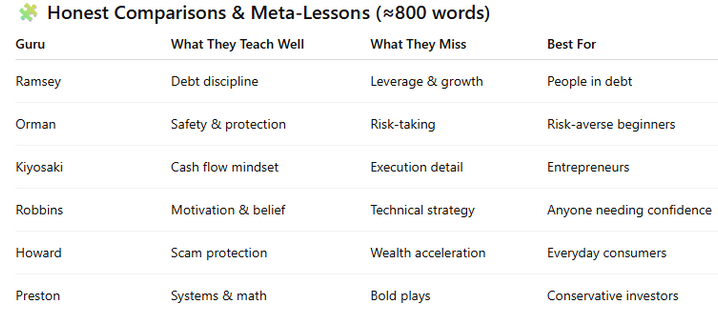
Meta-Lessons:
-
Gurus = partial maps.
-
Truth = scattered across them.
-
Integration = your job.
🏁 Conclusion: The Honest Truth
Gurus are valuable entry points. They awaken, protect, or inspire — but they cannot carry you all the way.
The honest truth: You must build your own integrated wealth system.
That’s where Life’s Wealth Quest steps in: not as a single-voice guru, but as a framework that merges the discipline of Ramsey, the protection of Orman, the cash flow of Kiyosaki, the belief of Robbins, the practicality of Howard, and the clarity of Preston — without their blind spots.
📚 Self-Study Course:
Step 1caa — The Guru’s: An Honest Opinion
📌 Objective
By the end of this self-study course, you will:
-
Recognize the strengths and weaknesses of major financial gurus.
-
Learn how to filter their advice without blind loyalty.
-
Build your personal “Guru Filter” for evaluating future voices.
⏱️ Suggested Pace
-
Total Time: 60–90 minutes.
-
Work across 2–3 sessions, or complete in one sitting.
🗂️ Course Modules
Module 1: Why Gurus Matter
Learn: Why financial gurus dominate the money conversation.
Reflect: Who was the first money guru you heard about? How did they influence you?
Action Worksheet: Write down 2 money beliefs you learned from a guru. Were they true, false, or incomplete?
Module 2: Honest Guru Profiles
Learn: Review the core teachings, strengths, and flaws of Ramsey, Orman, Kiyosaki, Robbins, Howard, Preston, and YouTube gurus.
Reflect: Which guru’s voice has been loudest in your life? Why?
Action Worksheet: Complete the “Guru Scorecard.” For each guru:
-
1 Truth they teach.
-
1 Myth or blind spot.
Module 3: Meta-Lessons
Learn: Gurus are partial maps.
Reflect: If you only followed one guru, where would it lead you (debt-free? safe but stuck? hyped but broke?)
Action Worksheet: Build your “Hybrid Guru Playbook.” Choose 3 truths (from 3 different gurus) you want to keep in your system.
Module 4: Create Your Guru Filter
Learn: Future gurus will emerge.
Reflect: How can you evaluate whether someone is worth listening to?
Action Worksheet: Write your “Guru Filter Questions,” such as:
-
Does this guru practice what they preach?
-
Are they teaching principles or selling hype?
-
Does this align with my wealth vision?
🏁 Completion Checklist
-
I identified 2 money beliefs I absorbed from gurus.
-
I filled out the Guru Scorecard.
-
I built a Hybrid Playbook with 3 truths.
-
I created a personal Guru Filter.